logo
  • Web Doctor
    • Web Doctor
    • About the Web Doctor
  • Therapy Plans
  • Nutrients
  • Integrative Medicine
  • About Us
    • Dr. med. Heinz Lüscher
    • Authors & Partners
      • Prof. Dr. Stefan Hockertz
      • Prof. Dr. Elmar Wienecke
      • Dr. med. Thomas Rau
      • Elisabeth Buchner
      • Links / Partners
    • Contact
  • Blog
  • EN
  • DE
Was suchen Sie heute?
logo


Was suchen Sie heute?
  • Web Doctor
    • Web Doctor
    • About the Web Doctor
  • Therapy Plans
  • Nutrients
  • Integrative Medicine
  • About Us
    • Dr. med. Heinz Lüscher
    • Authors & Partners
      • Prof. Dr. Stefan Hockertz
      • Prof. Dr. Elmar Wienecke
      • Dr. med. Thomas Rau
      • Elisabeth Buchner
      • Links / Partners
    • Contact
  • Blog
  • EN
  • DE
logo
Was suchen Sie heute?
  • Web Doctor
    • Web Doctor
    • About the Web Doctor
  • Therapy Plans
  • Nutrients
  • Integrative Medicine
  • About Us
    • Dr. med. Heinz Lüscher
    • Authors & Partners
      • Prof. Dr. Stefan Hockertz
      • Prof. Dr. Elmar Wienecke
      • Dr. med. Thomas Rau
      • Elisabeth Buchner
      • Links / Partners
    • Contact
  • Blog
  • EN
  • DE
logo
  • Web Doctor
    • Web Doctor
    • About the Web Doctor
  • Therapy Plans
  • Nutrients
  • Integrative Medicine
  • About Us
    • Dr. med. Heinz Lüscher
    • Authors & Partners
      • Prof. Dr. Stefan Hockertz
      • Prof. Dr. Elmar Wienecke
      • Dr. med. Thomas Rau
      • Elisabeth Buchner
      • Links / Partners
    • Contact
  • Blog
  • EN
  • DE
Was suchen Sie heute?
logo


Was suchen Sie heute?
  • Web Doctor
    • Web Doctor
    • About the Web Doctor
  • Therapy Plans
  • Nutrients
  • Integrative Medicine
  • About Us
    • Dr. med. Heinz Lüscher
    • Authors & Partners
      • Prof. Dr. Stefan Hockertz
      • Prof. Dr. Elmar Wienecke
      • Dr. med. Thomas Rau
      • Elisabeth Buchner
      • Links / Partners
    • Contact
  • Blog
  • EN
  • DE
logo
Was suchen Sie heute?
  • Web Doctor
    • Web Doctor
    • About the Web Doctor
  • Therapy Plans
  • Nutrients
  • Integrative Medicine
  • About Us
    • Dr. med. Heinz Lüscher
    • Authors & Partners
      • Prof. Dr. Stefan Hockertz
      • Prof. Dr. Elmar Wienecke
      • Dr. med. Thomas Rau
      • Elisabeth Buchner
      • Links / Partners
    • Contact
  • Blog
  • EN
  • DE
  • Web Doctor
    • Web Doctor
    • About the Web Doctor
  • Therapy Plans
  • Nutrients
  • Integrative Medicine
  • About Us
    • Dr. med. Heinz Lüscher
    • Authors & Partners
      • Prof. Dr. Stefan Hockertz
      • Prof. Dr. Elmar Wienecke
      • Dr. med. Thomas Rau
      • Elisabeth Buchner
      • Links / Partners
    • Contact
  • Blog
  • EN
  • DE

Mulberry leaves (Morus alba)

byDr. med. Heinz Lüscher March 29, 2021 0 comments

Mulberry leaves (Morus alba)

Dr. med. Heinz Lüscher

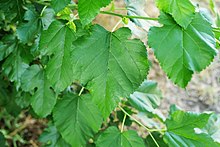
Mulberry trees are ancient and grow almost everywhere in the world. Several species are known, but we are particularly interested in the white mulberry (Morus alba). Its leaves were fed for years to silkworm caterpillars, but today we know that the leaves have a very special ingredient, one that is not found in any other plant.

The mulberry tree

Mulberry trees are among the oldest known trees. They have been known in Chinese folk medicine for over 5000 years, and they also appear in the Bible. Zacchaeus climbed a mulberry tree to see Jesus, and King David received instructions from God ‘in the tops of mulberry trees’. Mulberry trees grow almost everywhere in the world, in tropical, subtropical and even temperate northern zones. There are 16 species of this tree, e.g. the black or the red mulberry. Special mention should be made of the white mulberry (Morus alba), which we are talking about here. Mulberries are edible, their appearance reminds a bit of elongated blackberries. They come in white, black and red, but the species cannot be determined by the color of the fruit, because there are white mulberry trees with black berries, as well as black mulberry trees with white fruit. 
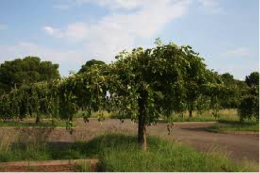
Mulberrry tree

Mulberry leaves (Morus alba) in the video

Learn more about the mulberry leaves and the vital substances it contains in the video with Dr. Heinz Lüscher.

Mulberry leaves

In Chinese folk medicine tea was brewed from mulberry leaves, which was used against fever and colds, but also to preserve the youthful skin and black hair.

For centuries, the mulberry leaves were used mainly as food for the silkworms, which eat practically nothing else. As long as there were no artificial fibers and silk was one of the noblest textiles, there were also large mulberry plantations of the white mulberry tree in Italy, but they have long lost their importance and have almost disappeared.
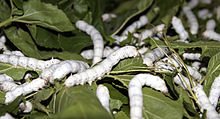
Recently, medical research undertaken in Japan has been responsible for a resurgence of interest in the healing properties of the mulberry leaves. The FAO (Food and Agricultural Organization of the UN) designated mulberry leaves as an ideal food for cows and other ruminants in 1990.

Ingredients

The leaves contain 15 – 25 % protein, which for a plant is a very high proportion. The abundance of nutrients when compared to green tea are seen below: (based on 100 g of dried leaves)

substanceMulberry Leavesgreen Tea
calciumironsodiumpotassium2700 mg44 mg3,4 mg3100 mg440 mg20 mg3 mg2200 mg
carotenevitamin Avitamin B1vitamin B2vitamin B3vitamin C7,4 mg4200 IU0,6 mg1,4 mg4,0 mg32 mg13 mg7200 IU0,4 mg1,4 mg4,0 mg250 mg
fibersinsoluble in watersoluble in water53 g45 g7 g11 g
Mulberry leaves

It is important to note that, compared to Green Tea, mulberry leaves have 6 times more calcium and twice as much iron.

Also important are the following micronutrients: zinc, copper, boron, manganese, fluorine and phosphorus.

Yet these factors around vitamins, minerals and trace elements is not what is of particular interest. Much more important is the content of amino acids, saccharides and phytochemicals. There are around 17 different amino acids to be found in mulberry leaves (building blocks of proteins), especially aspartic and glutamic acid.

Among the saccharides (sugars) we find sucrose, fructose, fructose and glucose. Various healing effects are the result of the flavones (rutin, isoquercetin, including carotene amongst others, a total of 3.3 g per 100 g).

This is only found in mulberry: 1-deoxynojirimycin (DNJ)!

The really outstanding thing about mulberry leaves is an alkaloid called 1-deoxynojirimycin (DNJ). This has a proven effect on diabetes mellitus (diabetes) and is a substance that is not found in any other plant in the world.
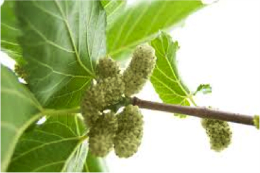
mulberry leaves
Share:
Likes:
0

Dr. med. Heinz Lüscher

Dr. med. Heinz Lüscher ist Orthomolekularmediziner, Vitalstoffexperte und leitender Arzt der Praxis Wise Medicine AG. Er ist begeistert von den Möglichkeiten, welche eine natürliche, nachhaltige und am Menschen orientierte Medizin bietet und will das Beste aus Schul- und Komplementärmedizin kombinieren.
Prev
Next

Leave a Reply Cancel reply

Your email address will not be published. Required fields are marked *

Advertising

Buy Mulberry leaves Morus Vida Supplements

Popular Posts

  • Helicobacter pylori infection – new approaches to a growing problem
    byDr. med. Heinz Lüscher March 10, 2026
    Helicobacter pylori infection – new approaches to a growing problem
  • Artemisia and oregano for HSV and HPV
    byDr. med. Heinz Lüscher February 4, 2026
    Artemisia and oregano for HSV and HPV

Web Doctor

Kostenlose Therapie-Empfehlungen in integrativer Medizin. Teste den Web-Doktor.

Free Guide

Nachhaltig gesund werden und bleiben? Lies den Ratgeber “Die Kraft natürlicher Vitalstoffe”.

Folge uns auf YouTube

Dr. med. Heinz Lüscher erklärt Vitalstoffe und deren Anwendung. Folge uns auf YouTube.

Recent Posts

  • Helicobacter pylori infection – new approaches to a growing problem
  • Artemisia and oregano for HSV and HPV
  • Longevity – Living better for longer (Part 2)

Die Natur hat auf (fast) alles eine Antwort. Lass uns diese Schätze neu entdecken!

  • Blog
  • About Us
  • Contact
  • Impressum

Therapy Plans

Hilfreiche Schemen zur Behandlung chronischer Erkrankungen. Nutze die Therapie-Schemen.

Articles about Nutrients

Diese Vitalstoffe und sekundären Pflanzenstoffe musst du kennen. Lies hier mehr über Wirkstoffe.

© integrativemedicine.info